

A Hidden Gem Ready To Shine
For the record, Paraguay is its own country. It was wiped almost off the map by Brazil and Argentina during the Triple Alliance War.
Mid-19th century, Paraguay was a wealthy nation thanks to protectionist dictators who happily exported tea and wood to the outside world but taxed imports heavily, creating a self-sufficient, wealthy, and (unlike neighboring Brazil and Argentina) debt-free country.
In fact, at the time, Paraguay was flush enough to pay cash for technology that allowed it to own its railroad. Elsewhere in the region, it was the British who owned and profited from the railway operations.
That healthy economy inspired an attempt to interfere with Britain’s tea monopoly in Europe, which led to the war of the Triple Alliance in 1864. Other stories about the start of this devastating conflict include that Paraguay was just trying to protect Uruguay’s independence and got tricked into a much larger-scale conflict. Still others say the dictator at the time, Francisco Solano Lopez, was delusional enough to attempt to take over South America.
Whatever the reasons for the war, the results were disastrous for Paraguay. By the end of fighting in 1870, the country lost more than a quarter of its territory, as much as 90% of its male population was killed, and it was required to pay restitution for the cost of the war to Brazil and Argentina. Brazil occupied the country for six years.
A century-and-a-half later, Paraguay is still trying to get back on the path to prosperity. One way it’s looking to do that is through tourism. The country’s newly-appointed head of the National Secretariat of Tourism (SENATUR) has outlined ambitious plans to increase tourist numbers from 2 million visitors a year to 10 million by 2037.
Additionally, Paraguay’s Migration Department and the Ministry of Industry and Commerce recently announced the launch of the Paraguay Investor Pass—a residency-by-investment visa. In exchange for a $150k investment in tourism projects or $200k in stocks or real estate investors receive permanent residency status. Paraguay Investor Pass holders also pay a decreased dividend tax rate (8% instead of 15%) and skip the country’s requirement for temporary residency status.
For now, in the live, travel, invest overseas world, Paraguay remains an underdog. I like underdogs. However, there’s a more compelling reason to be paying attention to this little-thought-of country right now. Paraguay doesn’t boast mega-tourist attractions, but it’s got something that should catch your attention as a global investor—a burgeoning agricultural industry and oodles of fertile land.
Paraguay is a leading global producer and exporter of niche agricultural products including stevia, organic sugar, and chia. It’s also a significant regional producer and exporter of soy, beef, corn, and cassava flour, contributing importantly to South American agricultural markets.
Go Offshore Today
Sign up to our free twice a week dispatch Offshore Living Letter
and immediately receive our FREE research report
on how to live tax-free today, while earning up to $215,200!
In addition, Paraguay is a competitive and tax-friendly investment hub. At some 400,000 square kilometers, it’s about the same size as California and home to a population of 7.1 million. The guarani is the official currency.
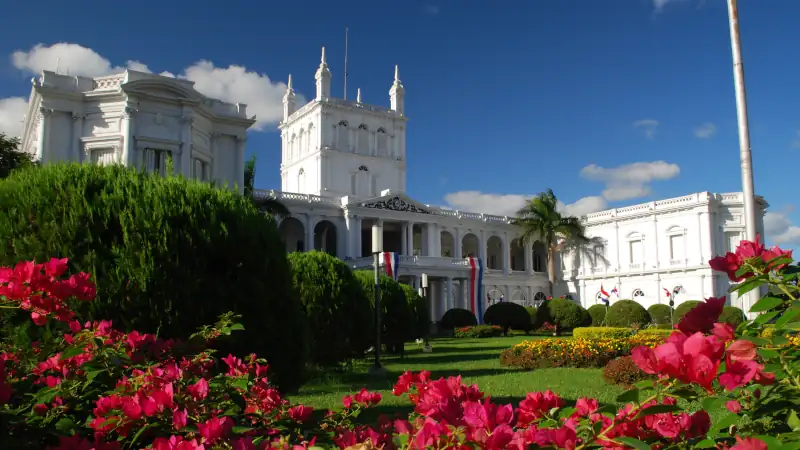
Paraguay’s capital, Asuncion is located on the country’s western edge alongside the Paraguay River (think Mississippi River) and serves as a regional hub. You can fly from Asuncion to most anywhere you’d want to go in South America—Buenos Aires, Montevideo, Sao Paolo, La Paz—within two hours.
Paraguay qualifies as a “blue ocean” market, an investment arena awash with opportunity, including in my primary investment focus: real estate. The very young population, as it matures, is going to need places to live, making the local housing market an interesting bet.
Perhaps the greatest appeal of this little-known country is the opportunity it offers for what could be considered the ultimate internationalization experience—disappearing. Indeed, it could be the thing the country is best known for historically…
Folks on the lamb from far and wide have sought out this country because it has something people who don’t want to be found appreciate: Super low population density, at least in parts.
Paraguay is divided in two by the Rio Paraguay. To the east of the river is the Oriente; to the west is the Chaco. Around 95% of the population live in the Oriente, leaving the Chaco—a region larger than the entire country of Uruguay—for the rest.
Easy in a place like that to get lost never to be found again if you don’t want to be.
That reality has contributed to Paraguay’s reputation as a global hide-out. I’ve met folks of all ages in the country who were attracted to this country initially for reasons that fall into this category.
Disappearing, dropping out, going off-grid, and living off the land isn’t for everyone. If your global diversification plans are less extreme, Paraguay still has a lot to offer…
Stay diversified,
Lief Simon
Editor, Offshore Living Letter