

Exploring The Philippines
On September 20, 1519, five ships set sail from the Spanish port of Sanlúcar de Barrameda. Aboard the Trinidad, San Antonio, Concepción, Victoria, and Santiago were 270 men.
The fleet (called the Armada de Maluco) journeyed across the Atlantic on its mission to discover a westward route to the Spice Islands—crucial to securing Spain’s future as an international power.
Leading the expedition was Portuguese explorer Ferdinand Magellan, a hardy soul who, along the way to the warm waters of the Pacific, survived numerous hardships, including mutinies, scurvy, storms, and the loss of both the Santiago and the San Antonio.
Then, in November of 1520, he sailed around the southern tip of South America, finding the strait named for him.
March of the following year, the remaining ships reached an exotic cluster of islands which Magellan named the Archipelago de San Lazaro (Archipelago of St. Lazarus).
The islands he “discovered” had in fact been settled thousands of years ago by Austronesian-speaking folks who had made their way there from Taiwan and mainland Southeast Asia. The extensive archipelago was divided into independent communities called barangays which were ruled by local chiefs known as datus.
Trade linked the islands to China, India, the Arab world, and neighboring Malay kingdoms—the strategic value of which didn’t go unnoticed by old Ferdinand. Additionally, it was rich in natural resources.
Magellan decided to stay a while and began trading with locals and making efforts to convert them to Christianity from Islam and the various other indigenous religions they practiced.
Ultimately a fallout with a local chief led to the Battle of Mactan where Magellan was sent on his final voyage to the pearly gates courtesy of a poison arrow.
But Spain’s interest had been piqued by tales of this exotic land rich in gold and spices and it wasn’t long before the crown dispatched further expeditions to the Pacific.
In 1543, Spanish explorer Ruy López de Villalobos failed in his bid to colonize the islands but did at least rename them. In honor of Philip II, who was Prince of Asturias and heir to the Spanish throne at the time, they became known as “Las Islas Felipenas”—The Philippine Islands.
Finally, in 1565, conquistador Miguel López de Legazpi, got the job done and Spain laid claim to the islands. They expanded control through military force, missionary activity, and alliances with local rulers, governing the islands from the capital, Manila. Catholicism became the dominant religion and Manila grew into a major center of trade between Asia and the Americas.
Fast-forward a few hundred years and resistance to Spanish rule had intensified. Filipino reformers and revolutionaries pushed for independence and then, in 1896, the Philippine Revolution began.
Two years later, the U.S. intervened and Spain soon surrendered, ceding the archipelago to the Americans under the Treaty of Paris for $20 million.
Meantime, the Filipino revolutionaries had declared independence and were none too happy with being sold off wholesale… and so began the Philippine–American War.
Following years of brutal battles and heavy losses, in 1902 the insurrection was effectively ended under the administration of President Theodore Roosevelt.
While maintaining political control, the U.S. introduced public education, English-language instruction, infrastructure projects, and civilian government.
In 1935, the Philippines became a U.S. Commonwealth and a promise of future independence was made.
Never a dull moment… along came World War II which saw Japan invade and occupy the Philippines. It was three years before American and Filipino forces retook the islands. A year later, in 1946, the archipelago’s fortunes finally turned around as the U.S. formally recognized Philippine independence.
The Philippines today is a democratic republic, home to over 110 million people—it’s one of the largest countries in Southeast Asia. It’s culturally diverse, strongly influenced by both Asian and Spanish traditions, and is one of the largest predominantly Catholic countries in the world.
The government follows a presidential system similar in structure to that of the U.S. The president serves as both head of state and head of government and is elected to a single six-year term.
Legislative power belongs to a bicameral Congress made up of the Senate and House of Representatives, while the Supreme Court heads the judiciary. The country is divided into provinces, cities, municipalities, and barangays (political subdivisions of cities and municipalities), with varying degrees of local autonomy.
The Philippines and the U.S. remain close allies, their modern security relationship rooted in the 1951 Mutual Defense Treaty which commits both countries to support each other in the event on an attack.
Although the major American bases at Subic Bay and Clark closed in the early 1990s, U.S. forces still regularly train and rotate through Philippine military facilities.
The U.S. also operates the Manila VA Outpatient Clinic, the only overseas facility run by the U.S. Department of Veterans Affairs, serving eligible veterans in the Philippines and making it a popular choice for retired veterans in particular.
Indeed, for anyone considering a move here the list of attractions is long… It offers Americans a blend of English-speaking convenience, quality private health care at affordable prices, a fairly easy visa process, and locals that will welcome you into the community and make you feel at home.
Go Offshore Today
Sign up to our free twice a week dispatch Offshore Living Letter
and immediately receive our FREE research report
on how to live tax-free today, while earning up to $215,200!
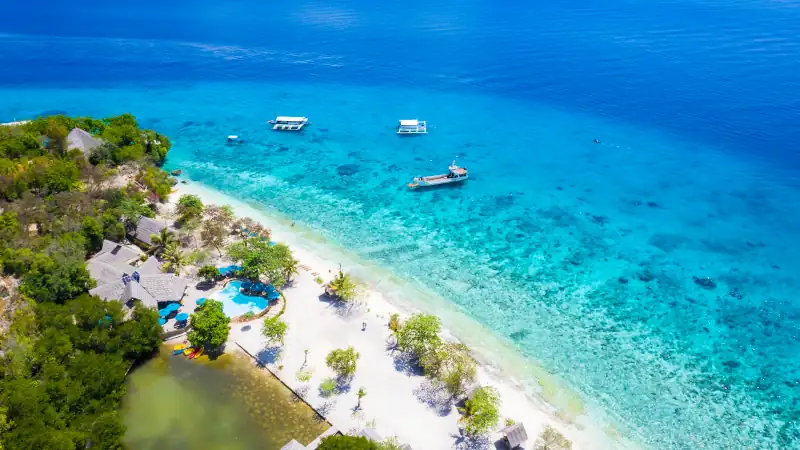
Across its more than 7,500 islands lie otherworldly landscapes of tropical beaches and crystal-clear waters. Add to that, a vibrant culture, low cost of living, rich history, and diverse experiences for every taste and appetite…
In entertainment hubs like Manila’s Entertainment City and Cebu City, ritzy resorts offer high-end gaming, gourmet restaurants, and luxury hotels. These areas provide expats with a cosmopolitan lifestyle similar to other major Southeast Asian cities, while still offering local cultural touches and a generally lower cost of living compared to say, Hong Kong or Singapore.
For golf enthusiasts private and semi-private country clubs offer championship courses, clubhouses, and social events. The Manila Polo Club, Sta. Elena Golf & Country Club in Laguna, and Apo Golf and Country Club in Davao are popular choices. Many of these clubs also include tennis courts, swimming pools, and dining facilities.
Yachting and sailing are equally popular in coastal regions; Subic Bay, Batangas, and Cebu all host marinas and yacht clubs that organize regattas, private charters, and sailing lessons.
Retirees on a budget also benefit from the low cost of living you can enjoy in the Philippines. In fact, a couple could live comfortably here from as little as $1,000 a month. For $2,300 per month, you could enjoy a luxurious lifestyle.
As many as 750,000 U.S. expats are thought to call the Philippines home including dual citizens, long-term residents, and retirees—some 60,000 of whom receive their Social Security payments in the country.
Plus, the Philippine government offers one of the best retirement programs for foreigners that comes with more benefits than any other country in the region and one of the easiest paths to permanent residency in Southeast Asia…
Stay diversified,
